Small earthquake south of St. Louis prompts renewed focus on regional faults and preparedness planning
A brief tremor, quickly assessed
A small earthquake was recorded Sunday south of St. Louis, producing shaking that some residents reported feeling but leaving no verified injuries or damage.
Seismologists use networks of sensors to estimate an earthquake’s location, magnitude and depth within minutes, then refine those values as additional data arrives. Even when a quake is modest, the St. Louis region’s geology can influence how widely the shaking is noticed, particularly in areas built on softer river sediments.
Why small quakes still matter in the St. Louis region
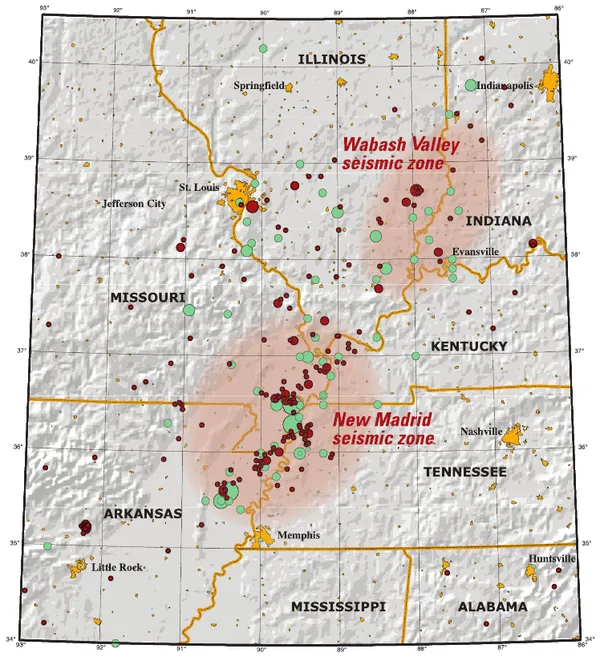
Southern and southeastern Missouri sit near a broader zone of intraplate seismicity that includes the New Madrid Seismic Zone, a historically active fault system responsible for the 1811–1812 earthquake sequence. The region continues to produce frequent low-magnitude events—many too small to be felt—along with occasional quakes large enough to draw public attention.
While the most damaging earthquakes associated with New Madrid occurred more than two centuries ago, modern monitoring has documented continuing seismicity across parts of southeastern Missouri, northeastern Arkansas, western Tennessee and western Kentucky. Earthquake risk in the central United States is shaped by both the likelihood of larger events over long time horizons and by local ground conditions that can amplify shaking.
What determines whether people feel an earthquake
Magnitude and depth: Shallow earthquakes can be felt more readily near the epicenter than deeper events of similar size.
Distance: Even a small quake can be noticeable close to its source, while larger events may be felt across multiple counties.
Local geology: Areas with soft sediments—such as portions of river valleys and floodplains—can experience stronger shaking than nearby bedrock locations.
Building response: Structures can rattle or sway in ways that make shaking seem stronger, especially in upper floors.
Context: recent seismic activity around the Metro area
The St. Louis area periodically experiences small earthquakes in nearby parts of Missouri and Illinois. In recent years, several low-magnitude events have been recorded in and around the broader region, typically with no damage reported. The central United States can also register earthquakes that are felt across wider areas than similar-sized events in the West, reflecting differences in how seismic waves travel through older, colder continental crust.
Preparedness guidance remains consistent
Emergency guidance for earthquakes emphasizes “Drop, Cover, and Hold On” during shaking, then checking for hazards such as gas leaks, damaged wiring, and unstable objects after the shaking stops.
For most residents, the practical takeaway from a small quake is not immediate danger but awareness: review household emergency supplies, secure heavy furniture, and know how to receive local alerts. Public agencies in Missouri and Illinois continue to encourage routine readiness given the region’s proximity to active seismic zones and the long-term possibility of stronger earthquakes.