Magnitude 3.5 Illinois earthquake felt across St. Louis region, highlighting persistent Midwestern seismic risk
Shaking reported around St. Louis after small Illinois-centered quake
A magnitude 3.5 earthquake struck in Illinois and was felt across parts of the St. Louis metropolitan area, prompting residents on both sides of the Mississippi River to report brief shaking, rattling and low-frequency rumbling consistent with a small, shallow seismic event.
Initial magnitude estimates for modest earthquakes can change as additional seismic data are processed, and the magnitude and location are typically refined in the hours following a quake. No immediate, widespread damage reports were confirmed as of publication, a common outcome for events in the mid-3 magnitude range.
Why a 3.5 can be noticeable in the St. Louis area
Even relatively small earthquakes can be widely felt in the central United States. The region’s geology allows seismic energy to travel farther with less loss than in much of the western U.S., meaning shaking that might be localized elsewhere can be noticeable across a broader area here. In addition, ground conditions matter: soft sediments in parts of the Mississippi River floodplain can amplify shaking compared with surrounding uplands, which can influence what people feel from the same event.
Seismic context: two active zones influence the metro area
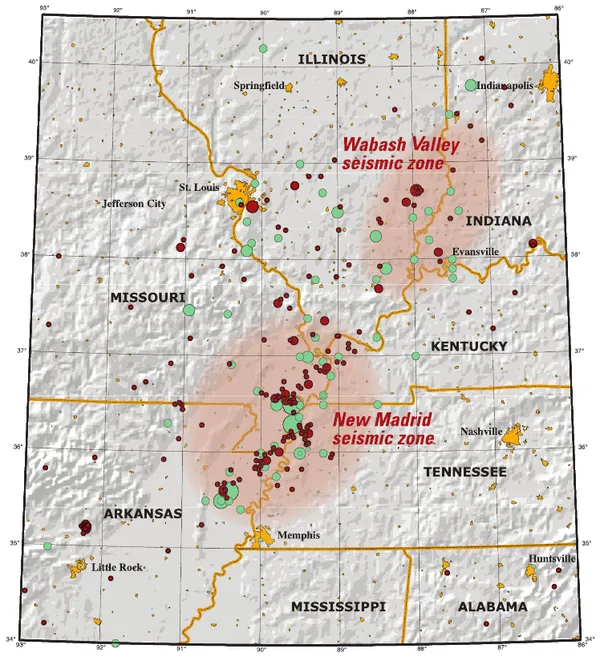
St. Louis sits within reach of multiple earthquake sources. The metro’s risk profile is shaped by its proximity to the New Madrid Seismic Zone and the Wabash Valley seismic zone, as well as smaller, more diffuse areas of seismicity in the broader region. USGS-led mapping and hazard work for the St. Louis area has documented that the region has experienced minor earthquake damage multiple times over the past two centuries, and that a large stock of older unreinforced masonry structures can be more vulnerable to shaking.
- New Madrid Seismic Zone: a concentrated area of ongoing intraplate seismicity in the central U.S. that can generate earthquakes felt well beyond the immediate epicentral area.
- Wabash Valley seismic zone: a significant source of Midwestern earthquakes that has produced damaging events historically and continues to generate smaller quakes.
How to interpret a magnitude 3.5 event
A magnitude in the mid-3 range is often strong enough to be felt indoors, especially at night when background vibration is low. People commonly describe sensations similar to a heavy truck passing, a brief jolt, or a rolling motion. While such quakes rarely cause structural damage, they can expose pre-existing weaknesses and underscore the importance of securing shelves, water heaters and heavy objects.
Earthquakes can’t be predicted, but the factors that shape local shaking—distance, depth, and soil conditions—can strongly affect what residents experience.
What residents should do next
Officials generally advise residents who felt shaking to check for minor household hazards (fallen objects, cracked glass, gas odors) and to be prepared for aftershocks, which are possible even after small earthquakes. Emergency planners also encourage maintaining basic supplies and knowing safe actions during shaking: drop, cover, and hold on.