Inside St. Louis’ vacant AT&T Tower as owner reiterates redevelopment plan tied to state tax credits
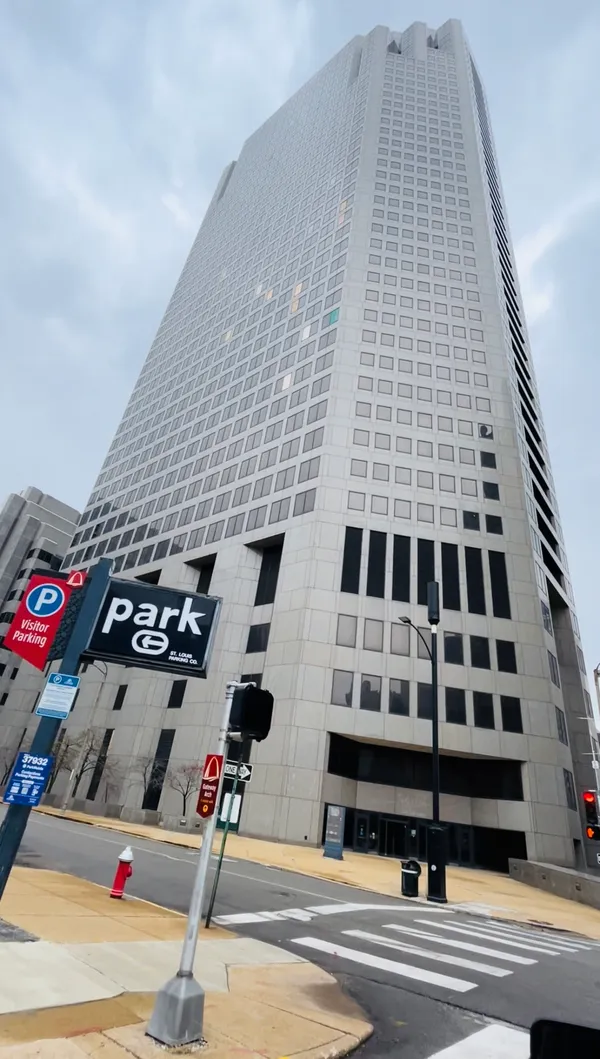
A landmark office tower at the center of downtown’s conversion debate
St. Louis’ largest office building by floor area—909 Chestnut Street, widely known as the former AT&T Tower—remains vacant nearly a decade after its primary tenant departed. The 44-story, roughly 1.45 million-square-foot building, completed in 1986, has become a prominent test case for whether large, aging office buildings can be repositioned for housing and mixed-use activity in a post-pandemic market.
On Thursday, the building’s current owner, Boston-based The Goldman Group, opened parts of the property for a look inside and reiterated its intention to pursue a large-scale redevelopment. The company has framed the effort as an office-to-residential conversion supported by retail and public-facing amenities, while acknowledging that financing and public incentives remain the key variables.
Ownership changes and a long redevelopment timeline
The tower’s path to its current proposal reflects years of stalled transactions and shifting reuse concepts. Earlier redevelopment discussions included a separate group’s attempt to pursue a major mixed-use plan that ultimately did not proceed. The building later sold in an online auction in April 2024 for about $3.6 million to an entity tied to The Goldman Group, a fraction of the price paid in the mid-2000s during the height of the office market.
The building’s historic status is also part of the financial equation. It was listed on the National Register of Historic Places in 2022, a designation that can enable developers to pursue historic rehabilitation tax credits, depending on a project’s design and compliance requirements.
What the current plan proposes inside the tower
The Goldman Group’s concept centers on converting 25 floors into an amenity-rich residential community expected to house more than 1,200 residents. Plans described by the ownership team include a mix of indoor and outdoor recreation features, shared gathering spaces, and a rooftop restaurant and bar, along with an observation deck and an event venue on an upper floor.
The proposal also calls for activating the first three floors with retail uses intended to serve residents and attract visitors. The building’s expansive, granite-clad lobby is being positioned as a signature feature, with concept elements that include a large water feature and redesigned public areas.
- Residential conversion: 25 floors, designed for a population exceeding 1,200 residents
- Public-facing uses: rooftop dining, observation deck, upper-floor event space
- Street activation: retail across the first three levels
Financing hinges on a new Missouri tax-credit proposal
Project timing remains uncertain after a similar state incentive proposal did not pass in 2025. The owner has said the redevelopment cannot be fully scheduled without clarity on public financing tools that would narrow the gap between conversion costs and achievable rents.
Legislation introduced for the current session—Senate Bill 869, titled the Revitalizing Missouri Downtowns and Main Streets Act—would establish state tax credits aimed at office-to-residential (and related mixed-use) conversions. The framework includes an annual statewide cap of $50 million, with a portion reserved for very large properties, and credit levels described as 25% or 30% depending on project eligibility criteria. Under provisions outlined in the bill’s structure, the program would take effect in 2027 and sunset in 2034 unless renewed.
The tower’s future now sits at the intersection of construction feasibility, state incentives, and downtown housing demand—factors that will determine whether one of St. Louis’ most visible vacant buildings can be repositioned into a residential address.
For city leaders and the development community, the AT&T Tower proposal is being closely watched as a potential bellwether for other large, underutilized downtown buildings facing similar market conditions.